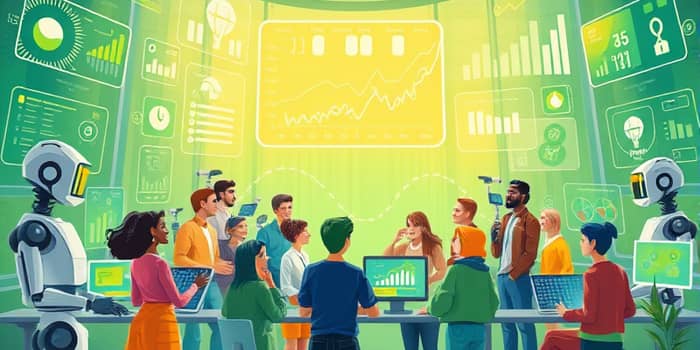
In an era of rapid digital transformation, the financial sector is undergoing a profound shift that goes beyond mere automation.
Finances 5.0 represents the evolution of finance aligned with Industry 5.0, prioritizing not just efficiency but also collaboration, resilience, and positive social impact.
This new paradigm emphasizes the fusion of economy and sustainable development, where financial practices drive innovation while fostering environmental stewardship and human well-being.
Finances 5.0 is defined as the next stage in financial evolution, building on the digital foundations of Industry 4.0.
It integrates cutting-edge technologies like artificial intelligence and robotics with a strong commitment to sustainability and ethical values.
The goal is to create a financial ecosystem that supports long-term prosperity for both people and the planet.
This approach moves away from pure profit maximization towards a balanced model that considers environmental, social, and governance factors.
Finances 5.0 is directly derived from Industry 5.0, which replaces the automated focus of its predecessor with human-machine collaboration.
Key elements include cobots or collaborative robots that work alongside humans to enhance productivity and creativity.
This extends to Society 5.0, a Japanese concept where technology serves human welfare, managing economic and geopolitical changes effectively.
The transition involves a shift from mass production to personalized, ethical services that cater to individual needs without sacrificing efficiency.
The foundation of Finances 5.0 rests on several critical pillars that guide its implementation and impact.
These pillars ensure that finance evolves to meet modern challenges while staying grounded in human values.
Adopting Finances 5.0 offers numerous advantages that can be quantified and qualitatively assessed.
These benefits highlight how Finances 5.0 can drive economic growth while addressing global issues like climate change and social inequality.
Despite its promise, Finances 5.0 faces several hurdles that companies must navigate to succeed.
Overcoming these challenges requires proactive adaptation and a commitment to continuous learning and innovation.
To understand the shift to Finances 5.0, it's helpful to compare the underlying industrial paradigms.
This table illustrates how Finances 5.0 builds on a more holistic approach, prioritizing human well-being alongside technological advancement.
Technology in Finances 5.0 is not just a tool for automation but a catalyst for sustainable growth.
Advanced systems enable real-time monitoring of environmental impacts and social outcomes.
For example, smart solutions like RPA can reduce waste and energy consumption in financial operations.
Sustainability is woven into every aspect, from investment decisions to daily transactions, ensuring that finance contributes positively to the planet.
This integration helps create a resilient financial system that can withstand crises and promote long-term stability.
For companies looking to transition to Finances 5.0, several actionable steps can facilitate the process.
By taking these steps, businesses can position themselves at the forefront of the financial evolution, reaping benefits while contributing to a better world.
Finances 5.0 is not a distant future but an imminent reality that demands attention and action.
It offers a blueprint for a financial system that is efficient, ethical, and empowering for all stakeholders.
By embracing its principles, we can unlock new opportunities for growth and innovation while safeguarding our planet and communities.
The journey requires commitment, but the rewards—a sustainable and prosperous future—are well worth the effort.
Referencias